








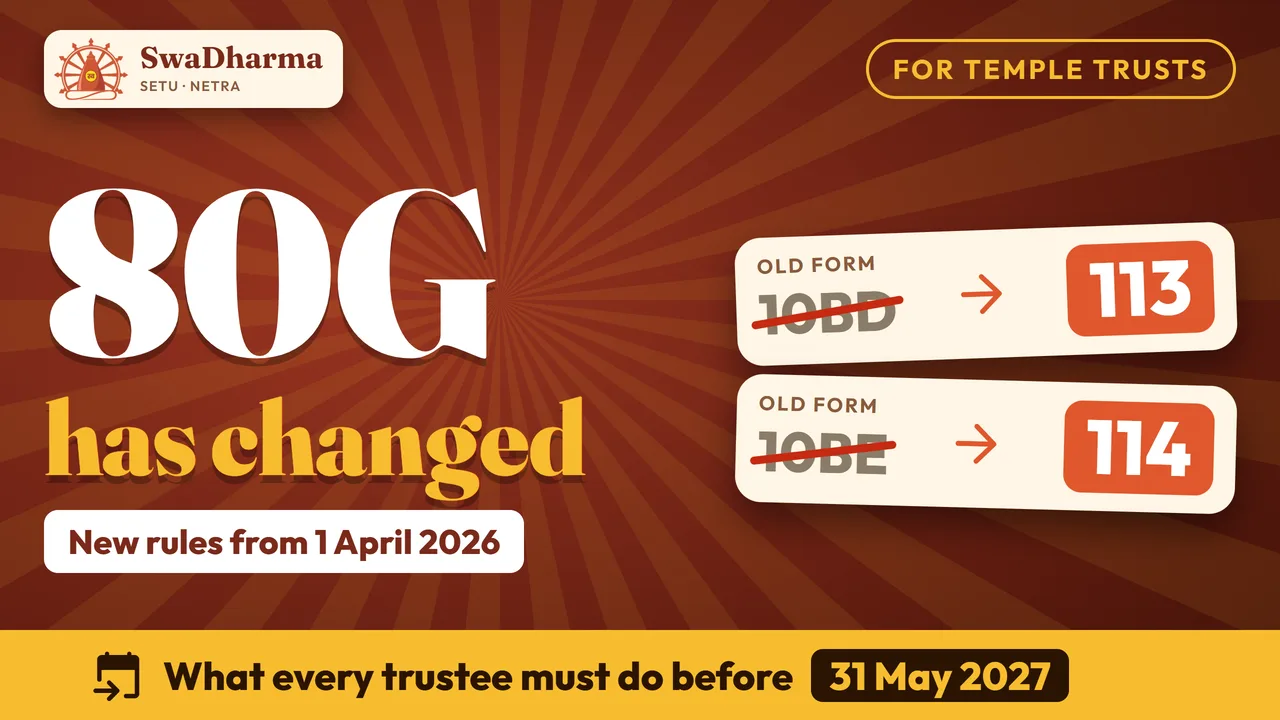


Guide · 2026 changes

Form 113 and Form 114 for temples: what changed from Form 10BD and 10BE, and what to do before 31 May 2027

The Income-tax Act, 2025 renumbered everything a trust files for donor tax deductions. Here is what moved, what stayed, and what a temple office should check now.

Updated 18 Nov 20269 min readBy the SwaDharma team

What changed in 2026?

From 1 April 2026 the Income-tax Act, 2025 applies. The donor’s deduction moved from section 80G to section 133, the trust’s approval to section 354, the statement of donations from Form 10BD to Form 113, and the donor certificate from Form 10BE to Form 114. The 31 May deadline, the ₹2,000 cash limit and the late fee are the same. Two things are new in the form: Aadhaar is no longer a donor ID, and donations are sorted into five types, including CSR.

Watch the video

The changes, explained in 8 minutes

For trustees and office staff who would rather watch than read: the new numbers, the two changes inside Form 113, one example from the donation counter to the donor’s certificate, and five points to note.

Video: 80G new rules 2026: Form 10BD is now Form 113, Form 10BE is now Form 114 Play video (8:06 minutes)
8:06 min · plays here from YouTube · Watch on YouTube

The short version

The numbers changed. The job did not.

An approved trust still reports its donations once a year and still gives each donor a certificate. Only the section and form numbers are new, so update the wording on receipts, notices and your website.

  • Devotees will keep saying “80G receipt”. That is fine in conversation.
  • For donations from 1 April 2026, the receipt should refer to section 133 of the Income-tax Act, 2025.
  • Our free 80G receipt format already uses the new wording.

Old number → new number

The donor’s tax deduction

Section 80Gis now Section 133

The trust’s approval to offer it

Section 80G(5)is now Section 354

Yearly statement of donations

Form 10BDis now Form 113

Certificate for each donor

Form 10BEis now Form 114

Unchanged: the 31 May deadline, the ₹2,000 cash limit, and the ₹200-a-day late fee.

Dates

Which form applies depends on the day the donation came in

The switch follows the date of the donation, not the date you file. Old-year records stay on the old forms, even if you correct them now.

  • Donations up to 31 March 2026: Form 10BD and Form 10BE.
  • Donations from 1 April 2026: Form 113 and Form 114, both due by 31 May 2027.
  • The portal offers the old and the new forms side by side.

Which form for which donation

  1. Up to 31 March 2026Donations in financial year 2025-26. The statement was due by 31 May 2026.Form 10BD + Form 10BE
  2. From 1 April 2026The Income-tax Act, 2025 applies. Donations fall in tax year 2026-27.Form 113 + Form 114
  3. 31 December 2026Commissioners decide the late 80G renewal applications that the CBDT condoned.Only some trusts
  4. 31 March 2027Tax year 2026-27 ends. Close the donor list.
  5. 31 May 2027File Form 113 and give every donor a Form 114 certificate.Deadline

Change 1

Donor ID: Aadhaar is no longer on the list

Form 10BD accepted Aadhaar, and many temple counters still write it on the receipt. Form 113 lists four kinds of ID, and Aadhaar is not one of them.

  • Ask for PAN at the counter and on the website donation form.
  • Look through receipts issued since 1 April 2026 that carry only an Aadhaar number, and ask those donors for PAN now.
  • The code numbers changed too. Check any old Form 10BD export template before you reuse it.

Donor ID codes in Form 113

  • 1Permanent Account Number (PAN)Ask for this first
  • 2Passport number
  • 3Elector’s photo identity numberThe voter ID card
  • 4Tax identification number of the country where the donor lives
  • Aadhaar, driving licence, ration cardAccepted in Form 10BD. Not listed in Form 113.

Change 2

Five donation types instead of three

Each line in Form 113 says what kind of donation it was. An ordinary gift now has its own line, “voluntary contribution other than corpus”, and money from a company’s CSR funds is shown separately.

  • Decide with your CA which of your donation heads belong to which type.
  • Do not tick corpus by default. Ask your CA which donations count as corpus.
  • Marking a donation as CSR records where it came from. It does not decide whether the company gets a deduction.

Donation types in Form 113

  • ICorpus donation
  • IIVoluntary contribution other than corpus New line
  • IIISpecific grant
  • IVDonation from a company’s CSR funds New line
  • VOthers, with a short description

Form 10BD had three: corpus, specific grant and others.

At the counter

Which temple receipts can carry a tax deduction?

Not every receipt a temple issues is a donation, and not every donation qualifies. This is for trusts that hold a current approval.

ReceiptCan the donor claim?What to do
Donation by UPI, card, cheque or bank transfer, with the donor’s PANYes, within the limitsReport it in Form 113 and give the Form 114 certificate.
Cash donation up to ₹2,000Yes, within the limitsRecord the donor’s details as for any other donation.
Cash donation above ₹2,000NoTell the donor before they pay. Section 133(5) allows the deduction only for non-cash modes above ₹2,000.
Donation in kind: rice, gold, clothNoOnly a sum of money qualifies, under section 133(4). Record it in your stock or valuables register.
Hundi and other anonymous offeringsNoThere is no donor to report or certify. Count it and account for it, and ask your CA how it is shown at audit.
Donor gives none of the four IDsNot until an ID is givenKeep a list of these receipts for your CA and follow up while the donor can still be reached.
Puja or seva booking, room or hall rentAsk your CAThese are usually payments for a service, not donations. Keep them under separate heads.

FAQ

UPI, hundi and donors who give no details

The questions a temple office meets every day at the QR code and the counter. How your own trust is classified depends on its deed and registration, so settle each one with your CA.

If a devotee pays by UPI and gives no details, is it an anonymous donation?

Usually yes, for the trust’s records. Section 355 of the Income-tax Act, 2025 calls a donation anonymous when the trust keeps no record of the donor’s name and address. A UPI reference shows that a payment arrived, not who gave it. If you can match the payment to a donor record that has the name and address, it is not anonymous.

Are the UPI ID, the payer’s name on the bank statement or the bank’s KYC enough?

Do not rely on them. A UPI handle or a payer name is useful evidence of the payment, but it is not a name-and-address record kept by the trust. Keep the payment reference, and collect the donor’s details through a short form, a phone number or the counter. Our guide to temple QR codes shows what to print beside the code.

Does a missing PAN make a donation anonymous?

No. Anonymous is about the donor’s name and address, not PAN. A donor whose name and address you hold, but who gave no PAN, is an identified donor. The donation simply cannot be entered in Form 113 with a PAN, so keep it on a list for your CA.

Is every anonymous donation to a temple taxed?

No. Section 337 leaves out a registered trust created wholly for religious purposes. A trust that is wholly charitable and religious is also left out, except for anonymous donations given specifically for a university, school, hospital or medical institution it runs. For other trusts, anonymous donations are taxed only above the higher of ₹1,00,000 and 5% of the total donations received in the year. Which group your trust falls in depends on its deed and registration, not on the word “temple” in its name.

Are small UPI donations exempt from these rules?

No. There is no exemption for a single small donation. The ₹1,00,000 or 5% limit is counted on the whole year’s donations. The ₹2,000 figure is a different rule: it only decides whether a cash donation can earn the donor a deduction.

A donor does not want their name shown. Is that an anonymous donation?

No, as long as the trust keeps the donor’s name and address in its own records. Leaving a name off a notice board, a donor wall or a website is a privacy choice. Anonymous, in the Act, means the trust itself has no record of who gave.

What if a donor will not give PAN, or has none of the four IDs?

Record the donation with the details you have, give an ordinary receipt for the money received, and keep the case on a list for your CA. Never fill in a made-up number, a trustee’s PAN or a staff member’s PAN to complete the file. Do not describe that receipt as a tax certificate until the ID is on record.

Can a mobile number or a UPI reference be used as the donor’s ID in Form 113?

No. Form 113 lists four IDs only: PAN, passport number, elector’s photo identity number and a foreign tax identification number. A mobile number or payment reference helps you find the donor again, but it cannot go in the ID column.

The donor says they do not want a deduction. Can we leave the donation out of Form 113?

Do not decide that at the counter. Whether a donation is reported depends on the trust’s approval and the kind of donation, not only on the donor’s wish. Collect the details in the usual way and let your CA decide what goes in the statement.

Is there a limit on cash a temple can accept from one donor?

Yes, and it is separate from the ₹2,000 rule. Section 186 bars anyone from receiving ₹2,00,000 or more in cash from one person in a day, for a single transaction, or for one event or occasion. Amounts of that size must come by account payee cheque, bank draft or an electronic mode.

Renewals

Filed your 80G renewal late? A CBDT circular may cover you

CBDT Circular No. 6 of 2026 helps one group of trusts: those whose approval was expiring on 31 March 2026 and who filed the renewal application after the 30 September 2025 due date.

  • If the application was filed online between 1 October 2025 and 31 March 2026, the delay is condoned.
  • That includes applications already rejected only because they were late.
  • The Commissioner is to pass an order on or before 31 December 2026. Ask your CA where your application stands.
  • The circular says plainly that it gives no automatic right to approval.

Late 80G renewal: who is covered

  1. Approval was expiring on 31 March 2026Renewal in Form 10AB was due by 30 September 2025, and the trust missed it.
  2. Filed between 1 October 2025 and 31 March 2026The delay is condoned, even if the application was already rejected only for being late.
  3. Order on or before 31 December 2026The Commissioner decides the application on its merits.

Not covered: automatic approval, or a new window to file late now.

For trustees

Six things to ask your CA this month

None of these needs software. Each one is cheaper to settle in November than in May.

  1. Is our approval current?

    Read the validity dates on the approval order. If it expired on 31 March 2026, ask whether the renewal falls under Circular 6 of 2026.

  2. Have our receipts changed?

    Receipts for donations from 1 April 2026 should refer to section 133 of the Income-tax Act, 2025.

  3. Which donors have no usable ID?

    List this year’s donors with only Aadhaar, or no ID, and ask them for PAN now.

  4. Which type is each donation head?

    Agree which heads are corpus, voluntary, specific grant, CSR or other, before the year ends.

  5. Which receipts are not donations?

    Agree how puja and seva bookings, room rent and hall rent are treated, and keep them apart.

  6. Who files, and when?

    Name the person who files Form 113 and sends the Form 114 certificates, and set a date well before 31 May 2027.

Where software fits

Who does what at year end

Netra, the receipt and billing software in Setu by SwaDharma, makes sure the donor’s details are there when the year closes. The filing stays with the trust.

Live

Netra, all year

Collects the details at the moment of giving, at the counter, on the website and at the kiosk.

  • Prints your trust’s approval number and wording on every receipt
  • Keeps the donor’s PAN as an optional, encrypted field
  • Exports donor-wise reports to Excel or CSV for your CA

Your trust or its CA, by 31 May

Prepares the upload from those reports and files it.

  • Checks approval dates and which donations qualify
  • Files Form 113 on the e-filing portal and e-verifies it
  • Sends each donor their Form 114 certificate

The income-tax e-filing portal

Receives the statement and produces the certificates.

  • Generates a Form 114 certificate for each donation reported
  • Issues Pre-ARNs for trusts that give manual certificates
  • Keeps Form 10BD and 10BE for earlier years
On this page
  1. Does our old 80G approval still count?
  2. The religious-purpose test is still there
  3. Late fee and penalty under the new Act
  4. Adding and correcting entries
  5. Sources

Last reviewed: 18 November 2026.

General information, not tax advice. What applies to your trust depends on your approval order, your trust deed and the current filing utility. Use this page to ask your chartered accountant better questions. Each point is linked to its source below.

Does our old 80G approval still count?

The change of Act did not renew any approval, and the official guidance so far covers only some cases. Read the validity dates printed on your own approval order, and confirm with your CA which donations it covers.

  • The Income Tax Department’s FAQ on the new forms says a provisional approval granted to a charitable institution under the 1961 Act is not invalid merely because the new Act began on 1 April 2026.
  • The same FAQ says registration applications filed in financial year 2025-26 and still pending on 31 March 2026 are decided under the 1961 Act, with no need to apply again only because the Act changed.
  • It does not speak about regular 80G approvals by name.
  • The e-filing portal keeps the old forms for earlier years and the new forms for tax year 2026-27 onwards, side by side.

Under the new Act, approval for donor deductions is in section 354. An approval runs for five tax years, or three where the trust’s activities have not yet started, and renewal must be applied for at least six months before it ends.

A ten-year registration is not a ten-year 80G approval

Registration (12AB, now section 332) covers the trust’s own income. Section 332(5) lets it run for ten years instead of five where the trust’s total income, before exemption, was not above ₹5 crore in each of the two preceding tax years. That is a different order from the approval that lets donors claim a deduction, which stays at five years. Keep two renewal dates in the diary, not one.

The religious-purpose test is still there

The rules that stop many temples from getting 80G approval carried over. Section 133(7)(b) still says a charitable purpose does not include one that is wholly or substantially religious. Section 354(1) requires that the institution is not expressed to be for the benefit of a particular religious community or caste, and that it does not spend more than 5% of its total income in a year on religious purposes. Our 80G guide explains what that means for a temple trust.

Late fee and penalty under the new Act

WhatIncome-tax Act, 1961Income-tax Act, 2025Amount
Fee for a late statement or certificateSection 234GSection 429₹200 for every day the failure continues, not more than the amount the failure relates to
Penalty the Assessing Officer may imposeSection 271KSection 464Not less than ₹10,000, up to ₹1,00,000

The larger cost falls on donors. Their deduction is allowed on the basis of what the trust reports, so a trust that does not file leaves its donors without the deduction they expected.

Adding and correcting entries

  • Missed some donations? File another original Form 113 with only the new entries. Do not repeat the ones already filed.
  • Wrong name, address or amount? File a revised statement. It can change or delete entries that were already reported.
  • No donations in the year? Form 113 is not needed.
  • Paper receipts with pre-acknowledgement numbers (Pre-ARNs)? A trust can generate up to 1,000 at a time, and must report the donations made against them in Form 113 before it can generate more.

Sources

The section text was read on Indian Kanoon, which is not an official site. Have your CA confirm it against the Act as amended by the Finance Act, 2026.


FAQ

Frequently asked questions

Something else? Write to sales.setu@swadharma.tech or book a demo.

What is Form 113?

Form 113 is the yearly statement of donations that an approved trust files on the income-tax e-filing portal. It replaced Form 10BD for donations received from 1 April 2026, and is due by 31 May after the year ends.

What is Form 114?

Form 114 is the certificate of donation a trust gives each donor so they can claim the deduction under section 133. It replaced Form 10BE. The portal generates it after the trust files Form 113, and it is due to donors by 31 May.

Is Form 10BD still used?

Only for earlier years. Donations received up to 31 March 2026 stay on Form 10BD and Form 10BE, and the e-filing portal keeps those forms available alongside the new ones.

What is the due date for Form 113 and Form 114?

31 May after the end of the tax year. For donations received between 1 April 2026 and 31 March 2027, both the statement and the certificates are due by 31 May 2027.

Does every temple have to file Form 113?

No. Only a trust that holds approval for donor deductions (80G, now section 354) and received donations in the year files it. If no donations were received in the tax year, the portal’s FAQ says Form 113 is not needed. A year with only unidentified donations is not the same as a year with none, so ask your CA.

Is the job finished once Form 113 is filed?

No. After filing and e-verifying the statement, the trust downloads the Form 114 certificates from the portal and gives one to each donor, also by 31 May. A printed receipt or a UPI payment message does not replace Form 114.

Are Pre-ARNs compulsory?

No. Pre-acknowledgement numbers are only for trusts that hand out manual certificates at the time of donation. They can be generated only during the tax year the donations belong to, up to 1,000 at a time, and the donations made against them must be reported in Form 113 before more can be generated.

Can a temple still take Aadhaar as donor ID for 80G?

Not for Form 113. The form lists four IDs: PAN, passport number, elector’s photo identity number and a foreign tax identification number. Form 10BD accepted Aadhaar; Form 113 does not list it, so ask donors for PAN.

Did the late fee or penalty change under the new Act?

The amounts did not. The fee is ₹200 a day under section 429 (earlier section 234G), limited to the amount the failure relates to, and the penalty under section 464 (earlier section 271K) is ₹10,000 to ₹1,00,000.

Is ₹1,00,000 the most a trust can be charged for filing late?

No. The ₹200-a-day fee under section 429 and the penalty under section 464 are two separate charges. The fee is limited to the amount of the donations the failure relates to, and must be paid before the late statement is filed. The ₹10,000 to ₹1,00,000 range applies only to the penalty.

Does the donor get half the donation back?

No. The deduction lowers the donor’s taxable income; it is not a refund. For a gift to an approved trust, 50% of the donation is deducted, and the donations that count are limited to 10% of the donor’s adjusted gross total income.

Can a donor on the new tax regime claim the deduction?

As we read section 202 of the 2025 Act, no: it allows only a few named deductions under the new regime, and section 133 is not one of them. A valid receipt or certificate does not change that. The donor should confirm with their own tax adviser.

Is our old 80G approval still valid after 1 April 2026?

Check the validity dates printed on the approval order with your CA. The Income Tax Department’s FAQ says a provisional approval under the 1961 Act is not invalid merely because the new Act began; it does not speak about regular approvals by name. Renewal must be applied for at least six months before an approval ends. See our 80G guide.

What does CBDT Circular 6 of 2026 do?

It condones the delay for trusts whose 80G approval was expiring on 31 March 2026 and who filed the renewal in Form 10AB between 1 October 2025 and 31 March 2026. Commissioners are to decide those applications on merits by 31 December 2026. It gives no automatic approval.

Does Netra file Form 113?

No. Netra prints your 80G registration number and wording on receipts, keeps donor PAN as an encrypted field and exports donor-wise reports. Filing the statement and issuing certificates is done by the trust or its CA on the e-filing portal.

Collect donor details at the counter, not in May

Netra prints your approval wording, keeps donor PAN encrypted and exports donor-wise reports for your CA.

  • 3-month free trial, no card
  • Counter, website and kiosk on one receipt ledger